Blog · Explainer
Li-ion vs LiFePO4 mini UPS: which chemistry belongs in a backup?
Phone batteries get all the attention. Tool batteries too, vehicle batteries — anything that moves. Almost everything written about lithium cells assumes that life: charge it, drain it, charge it again. A mini UPS battery does none of that. It sits plugged in, in a warm corner, full, for months. Then, a few hours a year, it has to work. That is float service, and float service is where the lithium-ion versus LiFePO4 question stops being spec-sheet trivia. Get it wrong and the backup quietly stops being a backup.
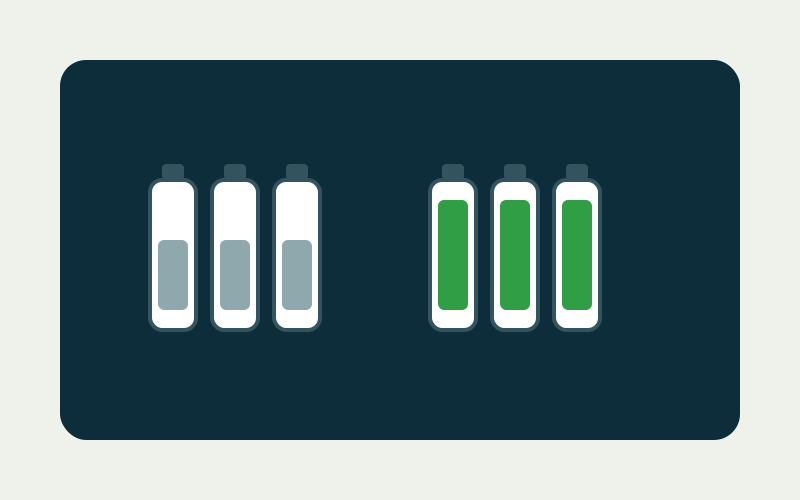
What float service does to a battery
Cells wear out two ways. Cycles wear them — every charge and discharge costs a little. And the calendar wears them: time, heat, and how full they sit, even if they never do a stroke of work. Float service is the second kind of wear on its hardest setting. Full charge. Indefinitely. Room temperature on a good day, warmer in most cabinets. Standard 18650 lithium-ion cells, the kind inside many compact mini UPS units, cope with this acceptably for a few years — and then they fade. Capacity drops year by year. Nothing breaks, nothing alarms, which is why the failure usually announces itself mid-outage, at the exact moment the battery was bought for. So state two things in the inquiry: the cabinet's temperature range, and the years of float service expected. With those, the chemistry recommendation can be argued from that fade profile instead of guessed.
LiFePO4 ages differently. Start with the cathode: it does not release oxygen the way standard lithium-ion cathodes can under abuse, and that single fact is the root of the chemistry's calmer thermal behaviour. It also shrugs off the two things float service dishes out — sitting at full charge, and deep cycling when the mains does fail — with much slower capacity loss. Numbers make the gap concrete. The Optima 303, the LiFePO4 model in this range, is rated for 4,000 charge cycles; consumer lithium-ion ratings live in a different world entirely. In float service the headline number is almost beside the point, though. Stability is the point. The 4,000 cycles are just the figurehead.
What LiFePO4 costs you
Nothing here is free. Watt-hour for watt-hour, a LiFePO4 pack is somewhat larger and heavier than a lithium-ion one, and the cells cost more. The Optima 304 makes the trade visible: 20,000 mAh of LiFePO4 40135 cells in a case measuring 150 × 85 × 47 mm, at 0.542 kg — visibly more box than a lithium-ion unit holding similar energy. Does the size matter? For a battery that never moves, mostly no; nobody carries a router UPS in a pocket. The price difference is real, though, and it should be spent only where the duty justifies it.
And do not mistake the 304 for a chemistry upgrade. It is a format choice: the same LiFePO4 chemistry at 20,000 mAh, with two 12V rails, a 9V rail, QC 3.0 USB and USB-C PD in a case that screws to a wall. If the 303's arithmetic convinced you, the 304 is what you buy when the device list — not the battery — is the thing that has grown.
So which installations should pay for LiFePO4?
Three profiles justify it clearly. First, the unattended installation: a relative's home network you maintain remotely, a holiday property, a remote monitoring point — anywhere a tired battery means a journey. Second, the hot installation: network corners in warm climates, sealed cabinets and sunlit rooms, where calendar ageing runs fastest and thermal stability matters most. Third, the long contract: installers and ISPs supplying backup as part of a multi-year service, where a mid-contract battery failure is not a shrug. It is a truck roll, and a reputation cost.
And the honest counter-case, because there is one: a home router in a mild climate, in a flat you live in, with a grid that blips rather than fails, is well served by standard lithium-ion. The multi-output Optima line and the 12V 2A Effcium class exist because most buyers are in that world. Chemistry is not a hierarchy; it is a match between a duty cycle and a cell. Read the installation first — years, temperature, attendance — and the chemistry chooses itself.
The cabinet test: temperature and float duty
The cycle headline hides a second difference: how the two chemistries age while doing nothing. And doing nothing is most of a mini UPS's life — fully charged, in float, often in a warm cabinet above a rack of equipment that heats the air for free. Lithium iron phosphate tolerates that duty — sustained full charge at moderate heat — with less capacity fade per year than the cobalt-based lithium-ion cells used in compact 18650 packs. For a unit installed in an unconditioned space in a hot climate, that difference can matter as much as the rated cycle count, and it is another reason fixed infrastructure skews LiFePO4 while portable and cost-led applications stay lithium-ion.
Weight argues back, though. Per kilogram, LiFePO4 stores less energy. Same watt-hours, heavier box. That is why the chemistry turns up screwed to walls and sitting on shelves rather than in pocket formats — and why the 5V camera model in this range stays lithium-ion. So, plainly: portable or price-led? Lithium-ion. Fixed, hot, long-contract or safety-specified? LiFePO4. Everything past that line in the comparison is marketing, and buyers can safely ignore it.
The 4,000-cycle data point, examined
Cycle ratings get quoted loosely, so pin this one down before it floats away: the 303's rating is 4,000 cycles from a 15,000 mAh LiFePO4 pack — a specification, not a slogan. Now do the division nobody does, with your own site's numbers. Count how often the backup at a site actually discharges in a year, and set that count against the 4,000: a site that cycles its backup weekly and a site that cycles it daily spend the same cycle budget at very different rates. Same number, wildly different purchases. Until you have counted your own site's duty, you do not actually know what you are buying.
The same discipline applies at the top of the LiFePO4 line. The 304: 20,000 mAh of the same chemistry behind five outputs — two 12V rails, a 9V rail, QC 3.0 USB and USB-C PD in a wall-mountable case. Buyers choosing between the two LiFePO4 models are not choosing chemistries at all. They are choosing formats and capacities.
Keeping the horizon honest
One last discipline keeps the whole comparison honest over time: write the expectation down. When a unit is installed, record which chemistry was chosen, what cycle duty the site was expected to impose, and the year by which the battery should be reviewed. Fleets that keep that note discover their real duty cycle within one replacement round — usually kinder than the guess, sometimes crueller, rarely equal to it — and every later purchase inherits the correction. The chemistry argument is never settled in general; it is settled per site, per duty, and the note is how the settlement accumulates.
Related pages