Blog · Explainer
PoE UPS explained: backup power over the network cable
Power over Ethernet is an elegant trick with an awkward consequence. A PoE camera has no power adapter and no power socket — it drinks its electricity from the same Ethernet cable that carries its video back. That is what makes PoE installations so tidy, and it is also why a normal UPS cannot protect them: there is no mains socket at the camera to back up, and a battery in the camera does not exist. The backup has to join the cable. A PoE UPS is the device that does that, and this explainer covers how it works and the two decisions that size it.
Where the PoE UPS sits
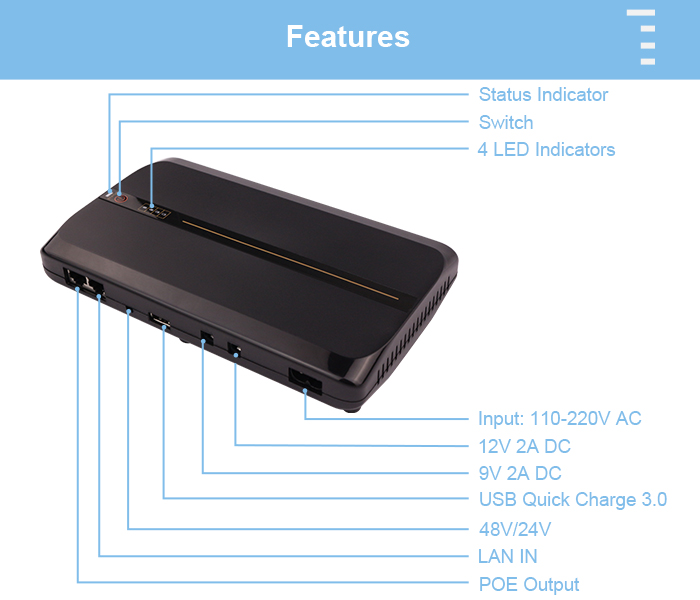
Picture the standard small installation: a camera on a wall or pole, a long Ethernet run back to a cabinet, and in the cabinet a switch or injector, a recorder and a router. The PoE UPS — an Ethrx-class unit — sits in the cabinet where the power already is. Mains power feeds the UPS; the UPS's PoE output port feeds the camera run, injecting DC power onto the cable alongside the data; and its plain DC outputs feed the cabinet's own gear. When the mains fails, the UPS's internal battery takes over every one of those outputs at once. That is the entire architecture: the far end keeps its cable and its camera; only the near end gains a battery.
The alternative architectures explain why this one wins. A standard AC UPS in the cabinet backing up a separate PoE injector works, but adds a conversion chain (battery to AC, AC back down to PoE DC) with losses and failure points at every step. Per-camera batteries multiply maintenance across the estate. A DC-native PoE UPS keeps the energy in DC from battery to camera, with no AC conversion stage in the path.
Decision one: 24V passive or 48V standard?
PoE comes in two voltage worlds. Standard PoE, the IEEE family used by most enterprise cameras and access points, delivers 48V. Passive PoE, common in wireless CPE and cost-optimised camera lines, typically delivers 24V, always on and without negotiation. The two are not interchangeable: a 24V device expects 24V and a 48V device expects 48V, and the feeds are not interchangeable. So the first sizing decision is a census — read every powered device's label and sort the estate by voltage.
The Ethrx line is built around exactly this fork: its PoE output is switchable between 24V and 48V. The P1 delivers PoE at 24V 1A or 48V 0.52A over a gigabit RJ45 link, so one unit type covers a mixed estate by configuration rather than by model proliferation. Mixed estates still need care per run (each camera run gets the voltage its camera expects), but the stocking and sparing problem collapses to one unit.
Decision two: watts and hours
With voltage settled, sizing is arithmetic. Add the camera draws (each camera's rated wattage), add the cabinet loads on the DC rails (recorder, router, switch), and the total must sit inside the unit's power class — 30W or 36W in this line. Take the Ethrx P1: 36W maximum across a switchable gigabit PoE port, a DC 12V 2A rail, a DC 9V 2A rail and a QC 3.0 USB port, with capacity tiers of 10,400 and 20,800 mAh. Hours follow the same rule as every backup: total load against stored energy. A camera estate that must record through the night does that same division with its night load and takes the tier the arithmetic returns.
One last practical note: link speed. A PoE port that negotiates only 100 Mbps can bottleneck a modern multi-megapixel camera stream or a gigabit CPE link, which is why the P1's PoE port is gigabit. Check it the way you check voltage — before the order. Voltage, watts, hours, link speed: four checks, in that order, and a PoE installation's backup design is done. The rest of the catalogue work — which sibling model for which cluster — is what the family page and the inquiry form are for.
Injectors, switches and where the UPS sits
Two installation shapes cover nearly every PoE backup job. In the first, a single camera or CPE radio hangs off an injector at the network edge; the UPS feeds the injector or replaces its power function, and the backup covers exactly one device. In the second, cameras converge on a PoE switch in a cabinet, and the backup question moves upstream: power the switch's feed, and every camera on it is covered at once — but the recorder and the router usually sit in the same cabinet and need DC rails of their own, which is why cabinet-class PoE models carry 12V and 9V outputs beside the PoE pair. Sizing follows the shape: device-class units for edge devices, cabinet-class units where the network converges.
One operational note completes the picture. Passive 24V PoE is always on — the pair carries power whenever the cable is connected — while standard 48V PoE negotiates before it energises. During an outage on battery, an always-on passive feed draws from the battery continuously even if the camera has rebooted into a fault state, which is worth knowing when runtime estimates are made for unattended sites. The standard's negotiation is not just elegance; on battery, it is thrift.
Meeting the sibling models
The P1 is this explainer's worked example, but it is not the model most estates should buy. If everything on your runs is 48V — no 24V stragglers hiding in the census — the P3 does the same 36 W, gigabit job as a 48V build. Smaller cabinets are the P5's business: tot up a camera, a recorder and a router and many real cabinets total well under the 36 W class, and the 30 W class exists for them. The P2 is the line's remaining model, quoted per estate like the others, for the estates whose device sits a whole cable run away from the nearest warm room. None of this changes the four checks. Voltage first, then watts, then hours, then link speed; run them in that order and the family mostly sorts itself. An estate standardised on 48V devices, with no passive stragglers, is the P3's ground — gigabit delivery at the standard voltage in the same 36 W class. A lighter cabinet, whose census totals well under the anchor class, is the P5's 30 W territory, and pays for no watts it will not draw. And the outdoor estates — CPE radios and cameras on masts and poles — are placed by the same four checks, with the battery kept at the warm near end of the run. The four checks from the sizing section (voltage, watts, hours, link speed) place each estate on its model; the models differ because estates do.
Record the settings, not just the unit
One habit is worth stealing from the estates that never have to ring anyone in a panic. When the cabinet door closes, nobody can see how the UPS was set: which PoE voltage each run got, what hangs on which DC rail, which tier went in. So write it on a card and cable-tie the card inside the door. Two years later, when a dead camera is replaced by one that needs the other voltage, that card is the difference between a five-minute settings change and a small disaster. It costs nothing. It has to be done at the one moment when somebody still remembers everything — which is the moment the install is finished, not the moment it fails.
Related pages