Application
Battery backup for CCTV cameras and recorders
A surveillance system that stops during a power cut stops at the worst possible moment. Cameras and recorders are backed up differently depending on how they are fed — over the network cable (PoE), by USB, or by a 12V adapter — and this page separates the three paths.
PoE cameras: back up the cable, not the camera
A PoE camera is powered by its Ethernet cable, so its backup has to speak PoE. The Ethrx line outputs switchable 24V or 48V PoE — gigabit on the P1 — and adds DC rails for the recorder or switch at the near end. One Ethrx unit at the cabinet therefore covers the camera at the far end and the gear at the near end on a single battery. Match the camera's PoE voltage first (24V passive or 48V standard), then its wattage against the model's power class (30W or 36W). The same unit's DC rails feed the recorder or switch at the near end, so both ends of the run sit on one battery budget.
5V and 12V cameras: the small-unit path
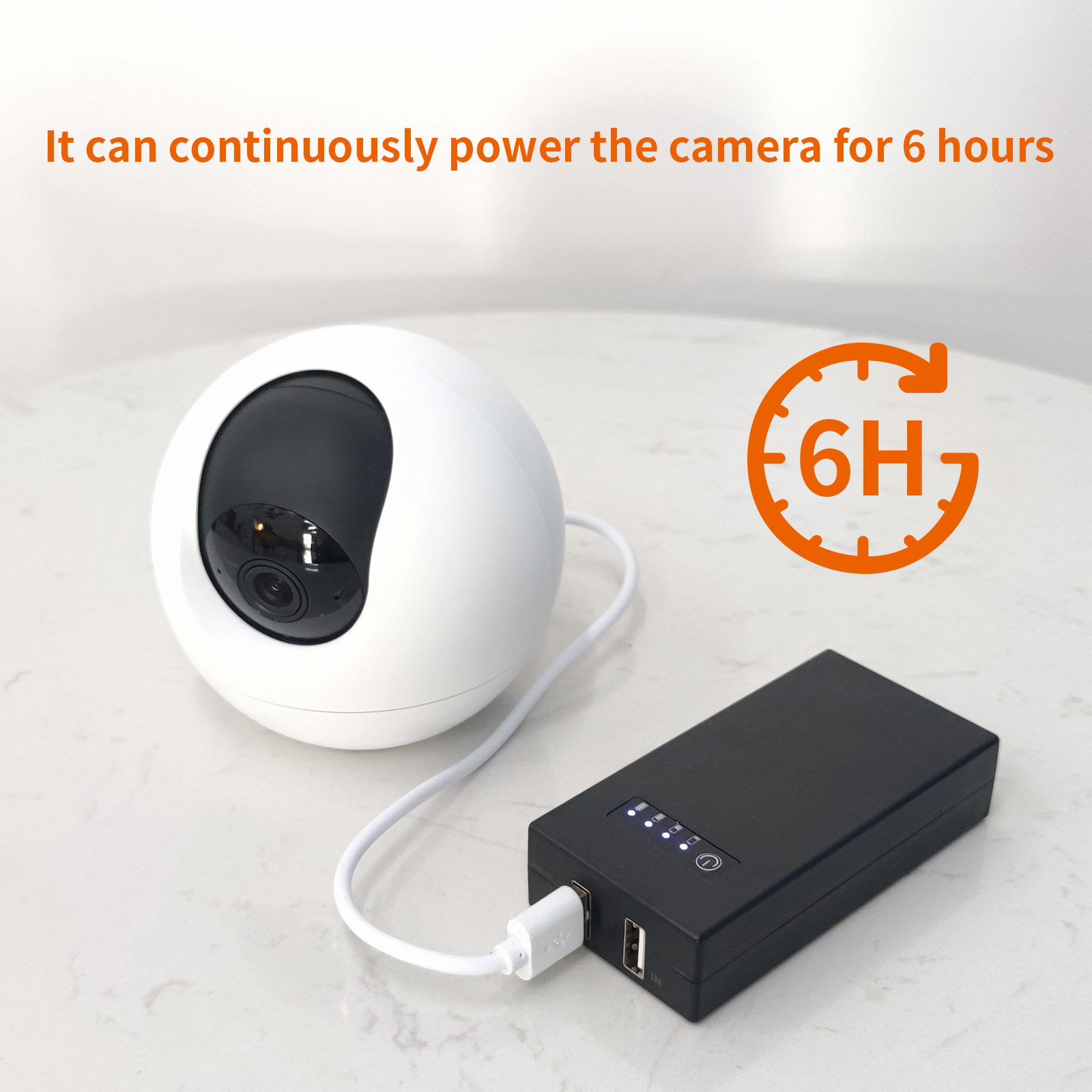
USB-powered cameras take the Effdum D5: a 5,200 mAh pocket unit with a 19.24 Wh pack and a backup time rated up to 6 hours. Cameras and recorders on 12V adapters scale with draw — a single camera sits inside the 12V 2A class, while a multi-channel DVR with a spinning disk belongs on the Maxora's 3A rail or the Boostra 106's 12V 5A online build.
Design the outage, not just the unit
Decide what the system must capture during an outage: the cameras alone, or cameras plus recorder plus the network that uploads the footage. Each added device joins the same battery budget, so the inquiry should list every load with its voltage and current — the reply can then map each device to a port and a runtime.
The camera census comes first
Camera backup is sized from a census, not from a camera count. For every camera the census records three facts: how it is powered (a local adapter at 5V or 12V, or PoE over its network cable), at what voltage and draw, and whether its footage is stored on the camera, on a recorder, or in the cloud. Those three facts route each camera to its backup family — 5V USB units for the USB-powered class, DC units for adapter-fed cameras, PoE units for cable-fed ones — and they expose the chain problem: a cloud camera needs its router alive to be worth anything during an outage, and a recorder-based system needs the recorder on the same battery budget as the cameras.
Night changes the arithmetic. Cameras with infrared illumination draw more after dark — exactly when outages matter most — and a runtime sized from a daytime label reading can disappoint by morning. The census should therefore use the camera's night draw where the maker states it, or assume the hungrier figure where it does not; the inquiry that flags an infrared estate gets the conservative arithmetic by default.
What 'covered' should mean
Coverage means the whole chain on one battery budget: cameras, recorder and network gear together. A camera feeding a recorder that has gone dark has nowhere to record to. This is why the application pages keep asking for the full chain in the inquiry: the configuration that covers the chain is usually a matter of port assignment across the units already chosen.
Related pages
Ask for a quotation
Tell us the model, the output voltages your equipment needs and the quantity band for your order. If you are matching a UPS to a router, camera or terminal, add the device's rated voltage and current.