Model · PoE
Ethrx P1 — gigabit PoE mini UPS
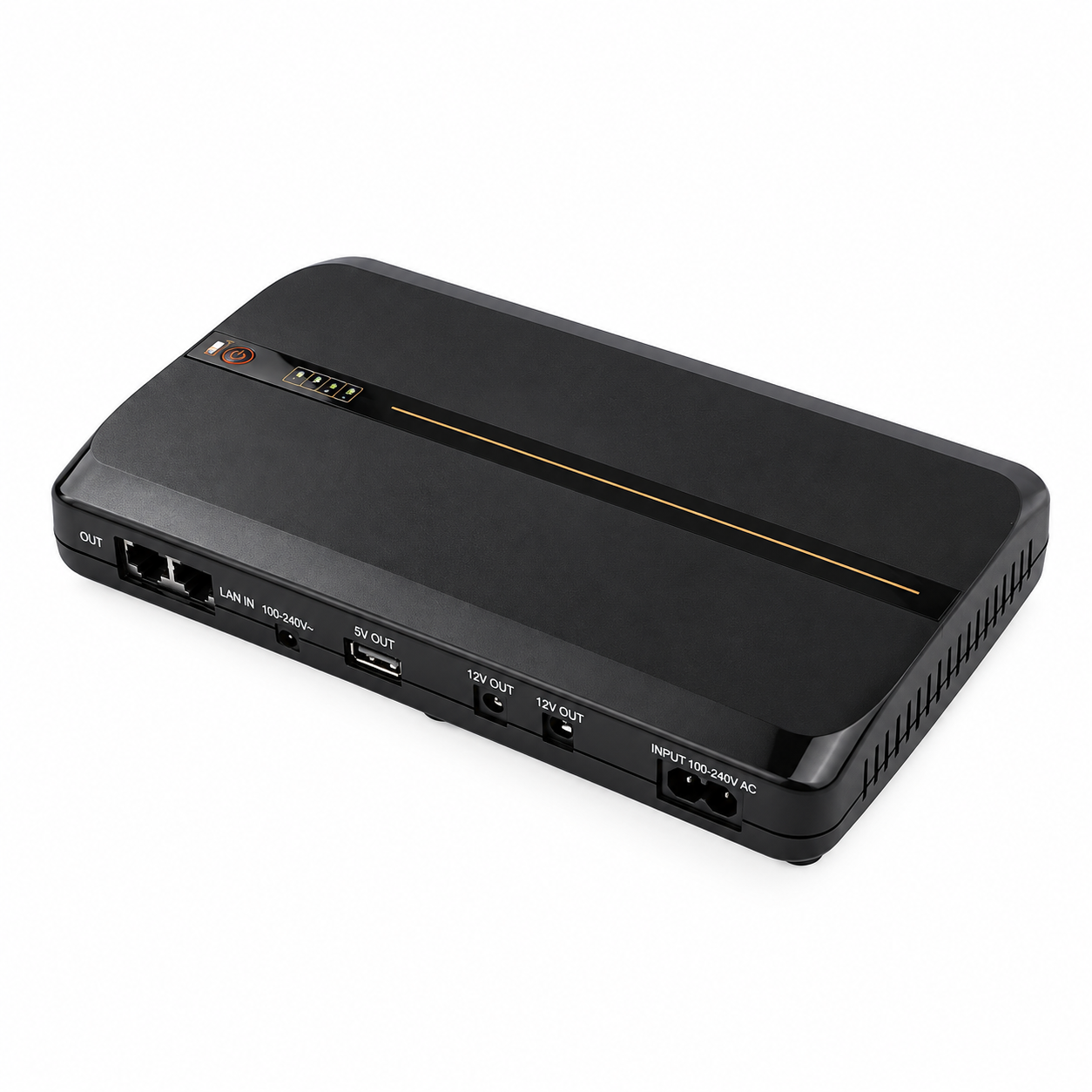
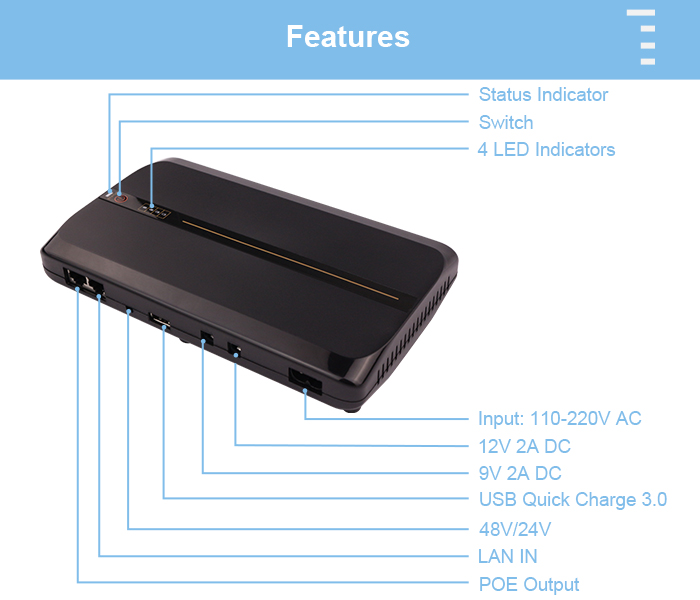
The Ethrx P1 anchors the PoE family: an AC-fed unit whose PoE port switches between 24V and 48V at gigabit speed, backed by DC 12V and 9V rails and a QC 3.0 USB port — one battery for the camera at the end of the cable and the network gear at the near end.
Specifications — Ethrx P1
| Model | Ethrx P1 |
|---|---|
| Battery type | 18650 lithium-ion |
| Input | AC 110–220V |
| Output power (max.) | 36W |
| PoE output | 24V 1A / 48V 0.52A, switchable · Gigabit RJ45 (1000 Mbps) |
| DC / USB outputs | DC 12V 2A · DC 9V 2A · USB 5V 2.5A (QC 3.0) |
| Capacity options | Basic 10,400 mAh (2,600 mAh × 4) · Pro 20,800 mAh (2,600 mAh × 8) |
| Size | 195 × 115 × 25.5 mm |
| Net weight | 0.62 kg |
One unit at the centre of the camera run
A typical PoE installation has three things that must not go down together: the camera, the switch or injector feeding it, and the router behind them. The P1 is built for that triangle. Its PoE port feeds the camera at whichever of the two common PoE voltages the camera expects — 24V or 48V, freely switchable — while the 12V and 9V DC rails carry the recorder, switch or router, and the QC 3.0 USB port covers a 5V device or fast-charges a phone.
Because the unit is AC-fed (110–220V input), it drops into the network cabinet in place of a standard supply: mains in, everything else out. The Pro tier doubles the pack to 20,800 mAh for sites whose cameras must record through long outages, not just blips.
Matching checklist
Confirm the camera's PoE voltage (24V or 48V) and draw, the link speed (the P1's PoE port is gigabit), and the DC loads' voltages, then state the capacity tier in the inquiry. The same checklist, answered once, sizes any model in this family.
The P1's capacity tiers and the cabinet budget
The P1's two capacity tiers — 10,400 and 20,800 mAh — serve the same 36 W output set, so the tier decision is purely about how long the cabinet must ride. A cabinet whose load is one camera and a router belongs on the smaller tier unless its outage history says otherwise; a cabinet feeding a camera, a recorder and the network pair, on a supply that fails for hours, is the larger tier's home ground. Because the tiers share one table and one case, the decision can be made late — even per cabinet, after the load census comes back — without disturbing the rest of the design.
The AC input deserves a line of its own in the plan. The P1 is mains-fed (110–220 V AC input), which places it in the cabinet beside the equipment it protects, drawing from the same supply whose failure it covers. No separate adapter enters the design; the inquiry needs the cabinet's load list and PoE voltage, not a power-supply conversation.
Sparing the P1 across a mixed estate
Because the P1's PoE voltage is set per installation rather than fixed per model, a single spare unit covers both voltage worlds in a mixed estate — the spare is configured at the cabinet, from the failed unit's recorded settings. Estates should record those settings (PoE voltage, tier, load list) in the cabinet or the asset register at commissioning; a spare configured from a written record is a ten-minute rescue, while a spare configured from memory is an audit performed under pressure.
Specification highlights — Ethrx P1
- Switchable 24V / 48V gigabit PoE output
- DC 12V 2A and DC 9V 2A rails plus USB QC 3.0
- 36W maximum output, AC 110–220V input
- 10,400 or 20,800 mAh capacity tiers
Related pages
Ask for a quotation
Tell us the model, the output voltages your equipment needs and the quantity band for your order. If you are matching a UPS to a router, camera or terminal, add the device's rated voltage and current.