Model · Multi-Output
Optima 301 — multi-output mini UPS
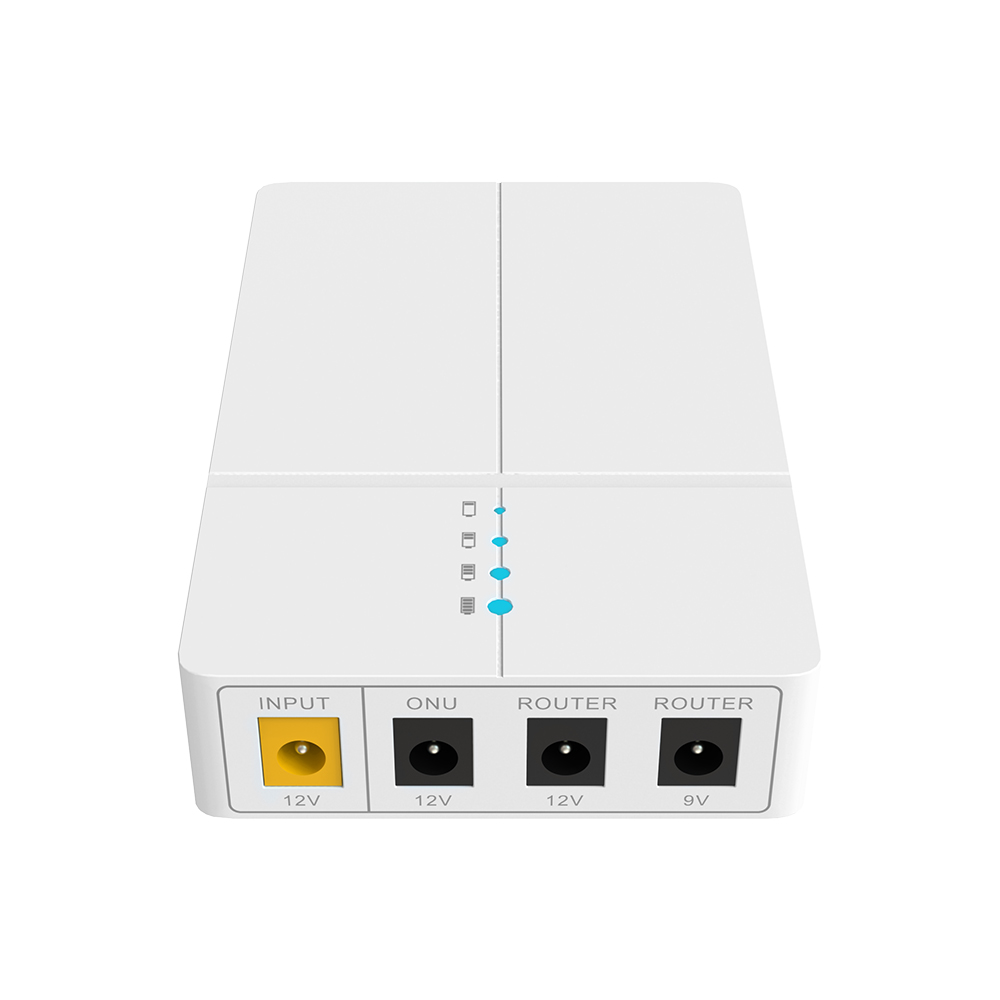
The Optima 301 powers a router, an ONU modem and a camera at the same time from one compact unit, with two 12V outputs and one 9V output running off a single 18650 battery pack. Three capacity tiers — 6,000, 7,800 and 9,900 mAh — sit behind the same port layout in the same case.
Specifications — Optima 301
| Model | Optima 301 |
|---|---|
| Battery type | 18650 lithium-ion |
| Input | DC 12V |
| Output power (max.) | 27W |
| Output ports | DC 1 / DC 2 / DC 3 |
| Output voltage | DC 12V · DC 12V · DC 9V |
| Output current | DC 12V 2A · DC 12V 2A · DC 9V 1A |
| Capacity options | Basic 6,000 mAh (2,000 mAh × 3) · Pro 7,800 mAh (2,600 mAh × 3) · Titan 9,900 mAh (3,300 mAh × 3) |
| Size | 110 × 73 × 24 mm |
| Net weight | 0.210 kg |
Built for the router-plus-modem corner
Most home and small-office networks fail as a set: the router, the optical modem and often a camera all lose power together, and the connection is only back when every box has rebooted and re-registered. The 301 covers the set in one unit — the two 12V rails take the router and a 12V camera or second device, and the 9V rail takes the modem. The model's battery life is up to 6 hours.
Port labels on the case name the intended loads (ONU, ROUTER), and LED indication shows the working state at a glance. Because the outputs are DC end to end, there is no inverter loss between the battery and the load.
Choosing a capacity tier
The three tiers use the same case and ports; only the cells change. The 6,000 mAh Basic tier suits short, frequent outages. The 7,800 mAh Pro is the balanced pick for a router-plus-modem pair, and the 9,900 mAh Titan tier is for buyers whose outages run long or whose 12V loads draw near the 2A rail limit. State the tier in the inquiry — pricing and runtime both follow from it.
Reading the three capacity tiers — Optima 301
The 301's three builds — 6,000, 7,800 and 9,900 mAh — are the same 27 W unit at three stored-energy sizes, not three different products. The port set, the input and the case stay constant; only the cell capacity behind them changes — the same three-cell layout at 2,000, 2,600 and 3,300 mAh per cell. That makes the tier choice a pure runtime decision, argued from the device list and the outage profile: stored energy divided by the set's actual draw. Because the tiers share one table, a buyer can also standardise on the mid build for a mixed fleet and reserve the 9,900 mAh build for the sites whose outage history justifies it.
A useful way to compare the tiers is by the load they carry rather than by the number on the box. A router drawing a steady third of the unit's 27 W ceiling treats the three capacities very differently from a modem sipping a tenth of it, and the model's battery life is up to 6 hours. The inquiry that gets the most useful reply therefore names the devices and their adapter ratings; the tier recommendation that comes back is then argued from those loads, not from habit.
Indicators, switch and enclosure — Optima 301
The unit's status display is a row of LEDs on the top face: a clear indication of remaining charge that a user can read at a glance without an app or a screen, which matters for equipment that lives in cupboards and ceiling voids. The power switch works on a one-click / double-click pattern — one click to switch on, a double click to switch off.
The enclosure is a flame-retardant housing.
In the box of the specification
- Three independent DC outputs: 12V 2A, 12V 2A, 9V 1A
- 27W maximum combined output
- 18650 lithium-ion pack in three capacity tiers
- Compact 110 × 73 × 24 mm case, 0.210 kg
Related pages
Ask for a quotation
Tell us the model, the output voltages your equipment needs and the quantity band for your order. If you are matching a UPS to a router, camera or terminal, add the device's rated voltage and current.