Model · Online
Boostra 106 — online UPS, 24V 3A
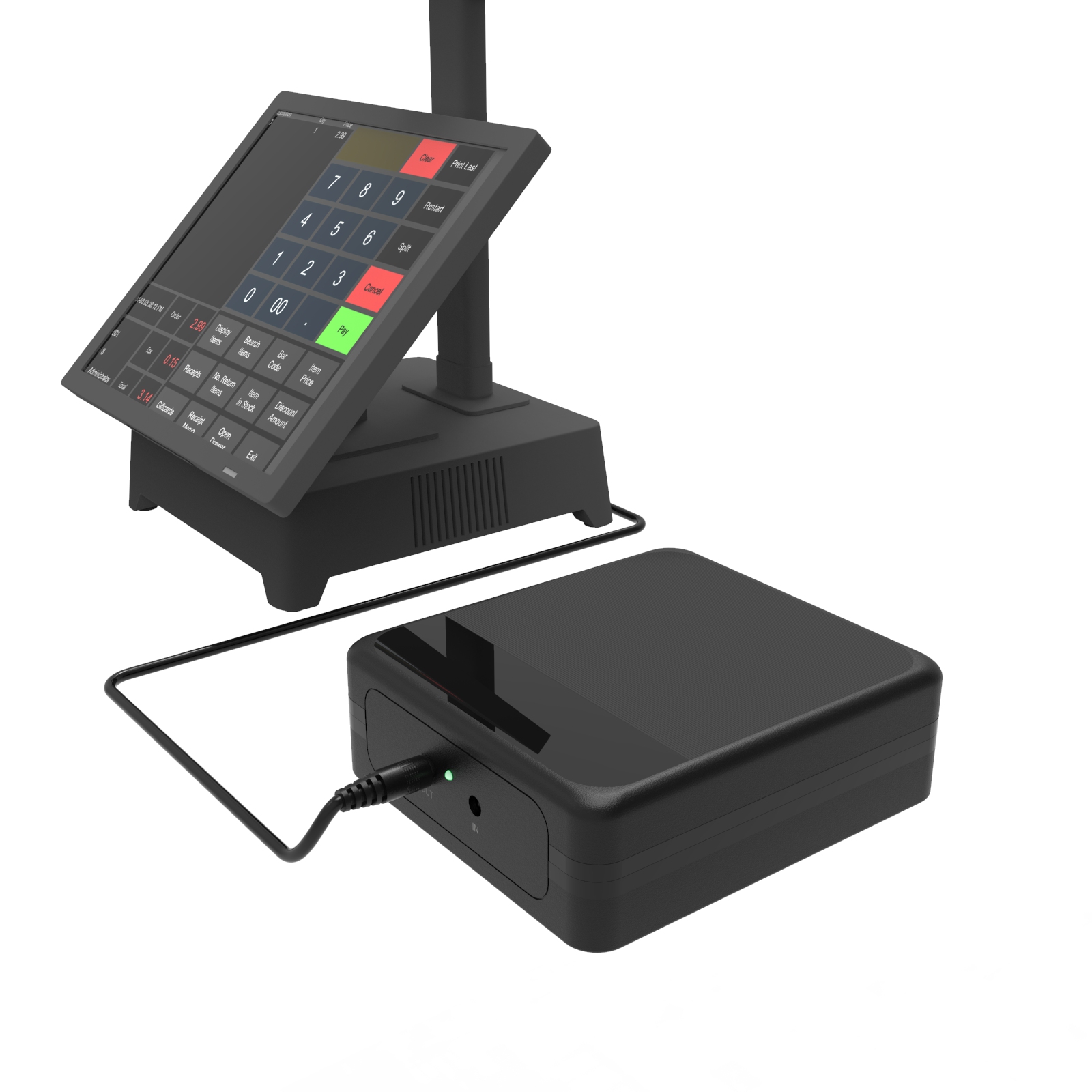
The 24V build of the Boostra 106 is a high-power online UPS whose load runs on the battery path permanently, delivering DC 24V at 3A (72W) to POS printers and 24V equipment.
Specifications — Boostra 106 24V
| Model | Boostra 106 (24V build) |
|---|---|
| Battery type | 18650 lithium-ion |
| Input | DC 24V |
| Output power (max.) | 72W |
| Output | DC 24V 3A |
| Capacity options | Basic 24,000 mAh (2,000 mAh × 12) · Pro 31,200 mAh (2,600 mAh × 12) · 88.80 Wh / 115.44 Wh |
| Platform voltage options | 12V 5A · 19V · 24V 3A |
| Size | 137 × 124 × 44 mm |
| Net weight | 0.78 kg |
Why online, in one paragraph
A standby UPS notices an outage and switches; an online UPS never has to. The 106 keeps its output on the battery path at all times — the architecture payment and recording equipment asks for, with a POS printer mid-receipt or a terminal mid-transaction as exactly the load it exists for — delivered here at desktop scale instead of rack scale.
Capacity comes in two tiers on the same case: 88.80 Wh (24,000 mAh) and 115.44 Wh (31,200 mAh) on the 24V build. Pick the tier by outage profile, and state it in the inquiry with the equipment's rated draw. Where an estate runs several 24V device classes, state each class's draw separately — the tier is picked against the heaviest continuous load, not an average of the list.
The 24V build's territory
The platform's 24V build — 24V 3A — serves the voltage class of industrial small equipment: the recorders, specialised terminals and control-adjacent devices that adopted 24V from the industrial world rather than the office one. Estates holding such equipment usually know exactly why they hold it, and their backup problem is that office-class UPS ranges stop at 12V. The 106 platform's answer is one platform across the voltage classes — the online architecture in each build, with the rail matched to the estate — so a mixed estate of 12V tills and 24V recorders backs up on one platform with one spares logic.
The two capacity tiers (24,000 mAh Basic, 31,200 mAh Pro; 88.80 and 115.44 Wh) sit in the 137 × 124 × 44 mm, 0.78 kg enclosure. A 24V device's draw should be totalled from its label before the tier is chosen; industrial devices often run continuously at their rated draw, without the idle valleys that office equipment enjoys, so their runtime arithmetic is the conservative version of the family's usual estimate. For that reason the inquiry should name the load's duty — continuous or intermittent — alongside its rating.
Continuous-duty loads and the tier choice
Industrial 24V loads differ from office loads in a way that flatters neither guesswork nor optimism: they run at their rated draw around the clock, without idle valleys. A recorder writing continuously, a controller polling continuously — their runtime arithmetic is simply watt-hours divided by watts, and the tier choice should be made on that unforgiving version of the maths. Buyers between tiers on a continuous-duty site should take the Pro; the Basic tier's economy is real only where the load's duty cycle leaves something to economise on. The inquiry that states the duty honestly — continuous or intermittent, with the hours — gets this call made on the right version of the arithmetic.
Specification highlights — Boostra 106 24V
- Online architecture — battery path at all times
- DC 24V 3A output, 72W maximum
- 24,000 or 31,200 mAh capacity tiers
- 137 × 124 × 44 mm desktop case, 0.78 kg
Related pages
Ask for a quotation
Tell us the model, the output voltages your equipment needs and the quantity band for your order. If you are matching a UPS to a router, camera or terminal, add the device's rated voltage and current.